Showing posts with label Dub. Show all posts

Wednesday, March 17, 2010

King Tubby-The Roots of Dub (1974)


"If you want to know where hip-hop came from, you can't ignore dub. If you want to check out early rap, you better be aware of toasting. All of those genres are products of the ghetto, inseparably tagged to the African diaspora. (Like most inventions of American popular music, as this blues/jazz/funk/hip-hop lover can readily attest.)

If you want to properly dig this music, go for the roots. A large number of those tentacles lie in the largest English-speaking island in the Caribbean, the celebrated home of the fruit called ackee, the world's epicenter of ganja (no excuses, Morocco), the source of Appleton Estate Rum (established 1655). Funny enough, King Tubby (né Osbourne Ruddock) was wearing some downright silly crowns back in 1974 (a Burger King indeed, if you look closely). I guess he hadn't yet established his reputation, which at this point is fundamental, monumental, and utterly essential. Those are the straight-up facts, and I dare you to disagree.

So dig back into the roots, before the Aggrovators collection Foundation of Dub, another '70s Bunny Lee production. Dub was created by subtracting vocals from popular reggae mixes and tweaking all the other instruments in the studio with little black boxes. Dubs started out as the "B" sides of singles.

King Tubby was the Dub Master, the Dub Organizer, the Dub Teacher, and the King. Personally tweaked tools, canny intuition, and divine inspiration all seem to come into play with his music, which is distinct from all the rest because of the utterly forward position of the bass and drums in the mix. You play dub, you play it loud, you want your chest to resonate with the music... it's a no-duh. Who knows how he hooked it all together in the studio, but maybe that's a secret better left untold.

When you take off on The Roots of Dub, you float gently along on reverberant waves of guitar, organ, and bass; reverb, delay, and echo always. All that sonic manipulation sounds restless and detailed, despite its utterly relaxed facade. The three-minute tunes ("compositions") might not be the most interesting at times—it's pop music, you have to remember—but there's no denying that King Tubby took each part of his starting material and melded them all into a dark, distorted shell of a song. Every time, always relying on texture, turning the purpose of the music into re-inventing the music.

That's King Tubby's story. If you already know him, you'll drown in ecstasy at this reissue of his first two records. (Please excuse the well-deserved hyperbole. Again, I beg you to disagree.) If you don't already know him, well, check The Roots out.

This music is deep to the core. Its kind of heavy meditation comes from deep Africa, like all the music of the diaspora, including flavors from closer to home. Fancy the two coming together to give birth to a new American music. Hip-hoppers everywhere, bow deeply and exhale."

Need I say more? Some of the finest Dub I've ever heard, perfect for this beautiful spring weather we've been receiving. Cheers.

A first class dub

Friday, February 12, 2010

Blind Idiot God-Undertow (1989)


"For its second album, Blind Idiot God enlisted the services of producer Bill Laswell, but the results show little difference from the attack evidenced on the band's initial release. Once again, the band alternates between surging instrumental barnburners like "Sawtooth" and "Drowning" and spare, evocative dub-oriented songs. Both are handled with the same imagination and confidence that the group had previously exhibited; this was one extremely tight and talented power trio. Andy Hawkins' compositions often take surprising turns during their short duration, themes bending and elongating in a manner providing delicious tension. Ted Epstein's drumming is a marvel to hear, combining an overwhelming strength with an unusual subtlety of rhythmic choices that one doesn't often hear in music as ostensibly rock-based as this. Two tracks stand out as departures from the group's first album: a cover of George Clinton's "Alice in My Fantasies" wherein Blind Idiot God shows that it can also handle power funk quite capably, and the final cut, "Purged Specimen." For this number, the trio is joined by saxophonist, composer (he wrote the piece), and lover of hardcore thrash John Zorn. The track sounds much more like a Naked City song than a typical Blind Idiot God rave-up though, again, it's an example of the band successfully navigating hitherto unexplored territory. Listeners who enjoyed the band's debut album will find more of the same here, even if they suspect that a bit of a rut is being established."

Quick upload. But recommended. Especially for you Dub fans. Trust me.

Watch yer step

Sunday, December 27, 2009

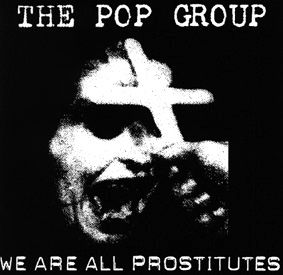
The Pop Group-We Are All Prostitutes (1980s/1998)


"It could have something to do with the fact that this is a compilation, but I still don’t buy it: judging from the tracklist of the other Pop Group LPs and comps, there’s not much of a difference here in terms of creating false cohesion, of bridging the lapses in a band’s output through the usual selective-memory procedures (Swell Maps, I’m looking in your direction)—everything seems to come from the same year or so, there’s a B-side here, but not much in the way of alternate mixes or singles-only tracks. In other words, there’s nothing that says the band couldn’t have put out this exact collection sometime before they imploded in 1980 or 1981. Therefore I have to conclude that this band just got a lot better: judging, after all, from the sporadically incoherent yet consistently bewildering Y, I was not sure if another Pop Group release was what I needed, at least right now. But here’s the incredible thing: whether it was because they spent more time hanging out with the Slits, or less listening to Crass and more listening to King Tubby, listening to this record is like watching the stoner in the back of your high school physics class suddenly start throwing out incisive questions about grand unified field theory. In short, it’s a tighter, far more accessible album that has the effect of retaining the righteous-activist’s indignation of Y while fusing the band’s unstable compound of disparate elements together into a listenable whole, intelligent enough not to fixate on the mirage of radical implications that often surround making inaccessible noise for its own sake.

The record certainly starts out letting one think the band’s succumbed to the seductions of fucking around: the indecipherable spoken sample and clattering rhythm track that begins “We Are All Prostitutes” in an appropriately extreme and caustic fashion is just deranged and alienating enough to make all who probably couldn’t make it through this album bail out immediately. But a minute into the track, a straightforward and well-conceived lyrical assault (“Aggression / Competition / Consumer fascism! / Capitalism is the most barbaric of our religions!”) rides atop what becomes a gutted-out disco bounce, replete with touches of scraping violin.

“Blind Faith” features an acute, head-spinning bass-and-drums groove that finally seems to realize the band’s promise of hybridizing JB’s, Gang of Four, and murky Kraut-inspired avant-ism: as Spartan yet instantly propulsive as anything recorded by ESG, the sinisterly muttered lyrics and threnodic horns take things in a grisly direction, yet the gradual acceleration of the track allows the ever-tight musicianship to expand itself in several directions at once without degenerating; an unexpectedly lovely percussive guitar coda that recalls Steve Reich is a welcome addition. “Justice,” another funk-driven track that’s heavy on the hi-hats, wah-pedal, and mind-bending noise effects in equal measure, features Mark Stewart’s most effectively, specifically exasperated vocal yet, railing against kangaroo courts, military aggression, imperialistic measures taken against Zimbabwe and Ireland. His saddened, I’ve-been-teargassed-too-many-times cries of “Who polices the police?” even echo Fela Kuti.

“Amnesty Report” sets just that—a report from Amnesty International of atrocities inflicted by the British on IRA members taken prisoner—atop an endlessly mutating, twitchy funk-and-percussion track that, while a tad Zappaesque and heavy on the found-sound spew, is one of the band’s most creative. Stewart here sounds colder, more sure of his convictions, than ever; if there was a campy and Jello-Biafra-like bemusement to be found in his previous vocals, there is, understandably, not a touch of it here. After that track grinds to a sudden halt, “Feed the Hungry” kicks in with an effective mixture of dancefloor groove and Remain in Light keyboard-drone psychedelia; Stewart again namechecks geographical locations of atrocity, all of which has is tersely broken down for the listener as follows: “The rape of the third world / World Bankers decide / Who lives and who dies.” (Even though the Illuminati is invoked, we can overlook it in this case.)

Breakneck, coming-apart-at-the-seams punk and bridge-burning funk are approximated on “Forces of Oppression,” which sounds a bit like “Give It Up and Turn It Loose” played by Ornette Coleman’s band circa his funky-catastrophe landmark Body Meta. It’s tracks like this one that require a cooldown like the sinister dub number “No Spectators,” a possibly Situationist-inspired indictment of all whose silent passivity implicates in atrocity. Of course, this is a heady charge to level against one’s audience, and it’s thankfully tempered throughout the course of the album to avoid simple dogmatism. The rousing, unexpectedly upbeat singalong of “Where There’s A Will” may be the highlight among all the offerings here; I can think of no more convincing offering of the post-punk era’s ability to assimilate what would appear to be incongruous idioms. Some delirious, downright Ohio-Players-esque guitar-and-bass runs and oddball Latin percussion keeps things appropriately joyous in the midst of struggle. Even if it’s a bleak one, it’s a party to which everyone’s invited."

Psycho crazy funked up political PUNK? You bet your ass.

EDIT: link fixed. my bad.

Where there's a will

Monday, November 16, 2009

King Tubby-Declaration of Dub (1970s?)


"King Tubby is to this day synonymous with dub. He was a man who had a passion for fiddling with sound equipment, and turned that passion into a new musical genre and a veritable art form. He may have started his career as a repairman, but before he was done, his name was one of the most respected around the world. He worked with virtually every artist in Jamaica, and his name on a remix was like gold, a seal of quality that was never questioned."

Not a whole lot of good info on this one but my roommate popped it on last night and I was flying. In orbit. So I believe this is a session from the 70s remixing some Bunny Lee tunes (like much of his output) and it bumps like some good Dub should. So what else do you need, right?

Thanks Robert. Good find.

Dub nasty

Monday, September 14, 2009

Mad Professor-Psychedelic Dub: Dub Me Crazy Pt. 10 (1990)


"A disciple of Lee "Scratch" Perry, Mad Professor was one of the leading producers in dub reggae's second generation. His Dub Me Crazy albums helped dub make the transition into the digital age, when electronic productions started to take over mainstream reggae in the '80s. His space-age tracks not only made use of new digital technology, but often expanded dub's sonic blueprint, adding more elements and layers of sound than his forebears typically did. In the mid-'90s, he returned to the basics, debuting a more retro-sounding style on the Black Liberation Dub series. Additionally, he ran his own studio and label, Ariwa, which was home to a stable of vocalists (with an emphasis on lovers rock and conscious roots reggae) and some of the finest British reggae productions of the era. As his reputation grew, he became a remixer of choice for adventurous rock and techno acts, most notably revamping Massive Attack's entire second album under the new title No Protection.

Mad Professor was born Neal Fraser (or Neil Fraser) circa 1955 in Guyana, a small country in the northern part of South America. He earned his nickname as a preteen, thanks to his intense interest in electronics; he even built his own radio. At age 13, his family moved to London, and around age 20, he started collecting recording equipment: reel-to-reel tape decks, echo and reverb effects, and the like. In 1979, he built his own mixing board and opened a four-track studio in his living room in the south London area of Thornton Heath. Calling it Ariwa, after a Nigerian word for sound or communication, he began recording bands and vocalists for his own label of the same name, mostly in the lovers rock vein: Deborahe Glasgow, Aquizim, Sergeant Pepper, Tony Benjamin, Davina Stone, and Ranking Ann, among others. Amid complaints from his neighbors, he moved the studio to a proper facility in Peckham, South London. In 1982 he recorded his first album, Dub Me Crazy, Pt. 1, and quickly followed it with a second volume, the successful Beyond the Realms of Dub. 1983 brought two more volumes, The African Connection (often acclaimed as one of his best) and the fairly popular Escape to the Asylum of Dub.

The Ariwa studio was moved to a better neighborhood in West Norwood during the mid-'80s, and upgraded for 24-track capability, making it the largest black-owned studio in the U.K. From there, Mad Professor really started to make an impact on the British reggae scene. He produced major hit singles for Ariwa mainstay Pato Banton and Sandra Cross, and also helmed the breakthrough album for conscious reggae toaster Macka B, 1986's Sign of the Times. At the same time, the ragga era was dawning, and all-digital productions began to take over reggae. As the ragga sound grew more and more dominant, Mad Professor's brand of dub got spacier and weirder; while ragga detractors complained that Mad Professor's work sounded sterile compared to the dub of old, many praised his otherworldly effects and inventive arrangements. The Dub Me Crazy albums reached the height of their experimentalism during the latter part of the '80s, although by the early '90s they were showing signs of creative burnout. The 12th and final volume in the series, Dub Maniacs on the Rampage, was released in 1993.

Meanwhile, Ariwa continued to prosper as a label, with further hits by the likes of Macka B, Pato Banton, Sandra Cross, female singer Kofi, Intense, Jah Shaka, John McLean, the Robotics, Sister Audrey, Peter Culture, Johnny Clark, and others. Additionally, he began to collaborate with some of reggae's better-known figures; most crucially, he teamed up with main influence Lee "Scratch" Perry for the first time on the 1989 set Mystic Warrior. In 1991, he produced the first of several albums for the groundbreaking veteran DJ U-Roy, the acclaimed True Born African; he also went on to work with the likes of Yabby You and Bob Andy. He switched his focus to touring in 1992 and released the 100th album on Ariwa not long after.

With his high-profile collaborators, Mad Professor started to make a name for himself outside of the reggae community, and soon found himself in demand as a remixer for rock, R&B, and electronica acts. Over the course of the '90s and into the new millennium, he would remix tracks by Sade, the Orb, the KLF, the Beastie Boys, Jamiroquai, Rancid, Depeche Mode, and Perry Farrell, among others. His best-known project, however -- and the one that truly established his credentials -- was 1995's No Protection, a completely reimagined version of trip-hop collective Massive Attack's second album, Protection. Perhaps creatively refreshed, Mad Professor's own albums started to regain their consistency in the mid-'90s. Mixing electronics with rootsier, more organic sounds indebted to the earliest days of dub, he left behind the Dub Me Crazy moniker to launch a new series, the subtly Afrocentric Black Liberation Dub. The first volume was released in 1994, and others followed steadily into the new millennium, albeit at a less prolific pace than the Dub Me Crazy installments. More collaborations with Perry and U-Roy followed as well. In 2005, Mad Professor celebrated Ariwa's 25th anniversary with a tour of the U.K. alongside Perry and the double CD retrospective Method to the Madness."

Awesome dub album for maximum stoned consumption. Many thanks to Robert for showing me this gem of an album. Highly recommended.

Dub me crazy

Tuesday, June 2, 2009

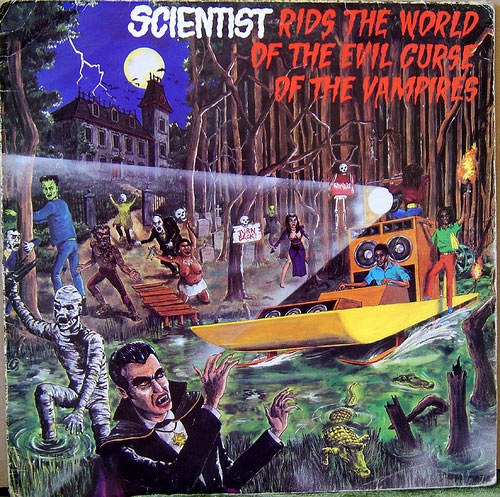
Scientist-Rids the World of the Curse of the Vampires (1981)...Awesome Dub!!!


I'll be completely honest in that I don't know much about Reggae, Dub, and the related genres. I know some heavy hitters and that's about it. I was bored one day and stumbled upon this album on the Glowing Raw (one of the best music blogs out there, you all must visit...that dude has gotten me into a shit ton of music). So I figured that I would give this a shot since he said it got him into Dub. And holy balls. Slow, bumping grooves, echo, delay and reverb everywhere, a cornucopia of stoned out noise with the beautiful warble of roots music in the background. This has been my choice lounge record of late since I am mostly sitting around getting stoned in absence of a real job. Cool for cruising too. I know this isn't a real review. Thanks to Alex over at Glowing Raw for this choice cut. Recommended.

REAL REVIEW:

"After a stint learning the dub craft from innovator King Tubby in the late '70s, Scientist began mixing his own sessions, coming up with a more wide-ranging and effects-riddled sound than that of his mentor. One of a handful of choice Scientist albums on the Greensleeves label, Rids the World of the Curse of the Vampires (1981) not only ably displays the mix masters varied approach, but clocks in as one of his best outings. While Scientist heeds Tubby's minimalist call with "strictly drum and bass" cuts like "Night of the Living Dead" -- spotlighting tightly wound guitar and organ chords for body -- he also expands things with a sunny mix of horns and bubbly keyboards on "The Mummy's Shroud" (as hard as it is to imagine sunshine with a ghoulish title such as this). Even without horns, Scientist keeps things lively with plenty of reverb and echo-treated percussion, ghostly piano parts, video game sound effects, and other various wobbly interjections from the mixing board. Pointing to his originality, Scientist doesn't just apply a few tweaks here and there, but heavily reworks the basic tracks -- here laid down by the fine Roots Radics band and produced by Henry "Junjo" Lawes (Don Carlos, Frankie Paul) -- then deftly integrates his panoply of effects into the cut-up mix. And adding to the record's expert evocation of the Halloween spirit are some fiendishly voiced intros, the cover art's cartoon potpourri of horror film characters, and the dubious claim made in the liner notes that Scientist mixed it all at midnight on Friday the 13th (reach for the flashlights kids). Along with Keith Hundson's Pick a Dub and Lee Perry's Blackboard Jungle Dub, this excellent Scientist release is one of the essential dub albums available."

And tell me if you want more of this, you sweaty rogues, you. I have more. It's all excellent.

Dubliscious